Brazil will enforce new biofouling regulations under NORMAM-401 from 10 June 2026, introducing stricter compliance requirements for vessels calling Brazilian ports. These rules align with IMO Resolution MEPC.207(62). Although the requirements become effective in June 2026, penalties for non-compliance are not expected to be enforced until January 2028, providing owners and operators with additional time to achieve full compliance. For background, please refer to the original advisory https://www.iss-shipping.com/advisories/brazil-new-hull-fouling-regulations/.
Key Updates from Latest Guidance
- Sanctions for Non-Compliance:
- Monetary fines up to BRL 2 million.
- Possible vessel detention, with aggravated penalties for repeat offences.
- Enforcement Status:
- No official instructions yet on:
- How inspections will be conducted.
- Which documents will be systematically requested.
- Whether fines/detention will be immediate or if corrective measures (e.g., hull cleaning) will be allowed first.
- Clarification requested from the Directorate of Ports and Coasts (DPC); updates will follow once received.
- No official instructions yet on:
- Compliance Focus:
- Maintain a Biofouling Management Plan and Record Book onboard.
- Hull condition should remain within acceptable limits (microfouling only).
- Cleaning required only if macrofouling (Level 2 or above) is identified, subject to prior authorisation.
- Alignment with IMO Guidelines:
- Requirements mirror IMO Resolution MEPC.207(62).
- Most vessels already operating under IMO standards should be compliant.
- Current Understanding:
- Regulation aims at preventive compliance, not immediate restriction of port calls.
- NORMAM-401 will enter into force on 10 June 2026. However, the application of penalties for non-compliance has been postponed until January 2028, allowing a transition period for the industry to adapt to the new requirements.
Observation – Vessels subject to Environmental Licensing:
- The DPC clarified that vessels engaged in activities that require an Environmental License such as subsea cable laying, seismic and survey operations are not subject to Chapter 4 of NORMAM-401 (Biofouling).
- For these vessels, all matters related to hull condition, marine growth and environmental risks are governed exclusively by the conditions of the Environmental License issued by the competent environmental authority, and not by the biofouling requirements of NORMAM-401.
Cabotage vessels operating within the same biogeographical region
The DPC further clarified that vessels engaged exclusively in cabotage operations within the same biogeographical region of Brazilian Jurisdictional Waters (AJB) are subject to a simplified scenario.
For such vessels, inspection and/or hull cleaning would only be required in the following situations:
- Departure from and re-entry into Brazilian Jurisdictional Waters (AJB);
- Transit between different biogeographical regions;
- Remark. Once the report validity expires, a new inspection/cleaning report will only be required for transit between different biogeographical regions or for re-entry into Brazilian Jurisdictional Waters (AJB). If the vessel remains operating within the same biogeographical region, renewal of the report is not required.
The DPC also clarified that NORMAM-401 does not provide for the issuance of exemption certificates, exception letters, or any equivalent document by the Maritime Authority for these cases.
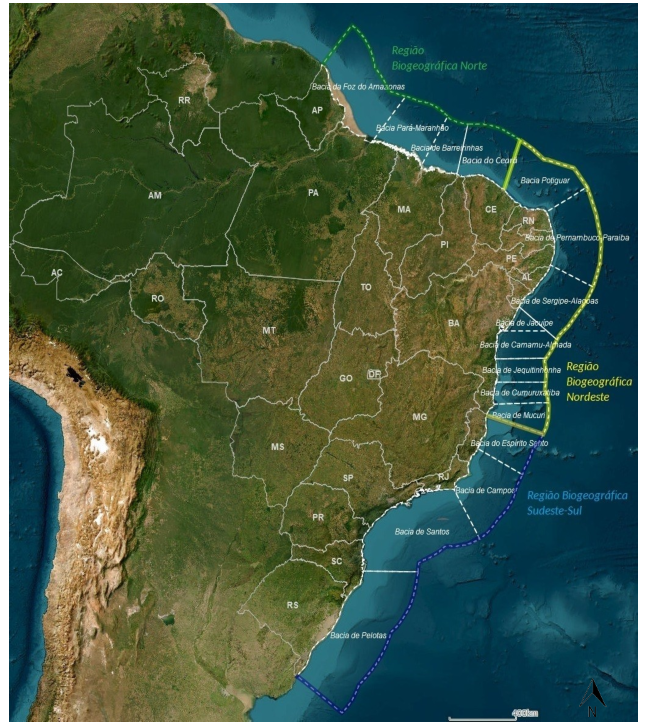
Brazilian biogeographical regions
According to Chapter 4 of NORMAM-401, the Brazilian coast is divided into three main biogeographical regions for biofouling management purposes:
North Region
Area between the Amazon Maritime Basin (Amazon River Mouth) and the Barreirinhas Maritime Basin, limited to the east by the Ceará Maritime Basin (Alto de Tutóia).
Northeast Region
Area extending from the Ceará Maritime Basin (starting at Alto de Tutóia) up to the Mucuri Maritime Basin (Mucuri River).
Southeast-South Region
Area extending from the Espírito Santo Maritime Basin (limited to the north by the Mucuri River, southern limit of Bahia State) up to the Pelotas Maritime Basin (limited to the north by the South Atlantic Subtropical Convergence Zone – parallel 28° S – and extending southwards to the border with Uruguayan territorial waters).
Illustrative Map – Brazilian Biogeographical Regions (North, Northeast and Southeast-South)